
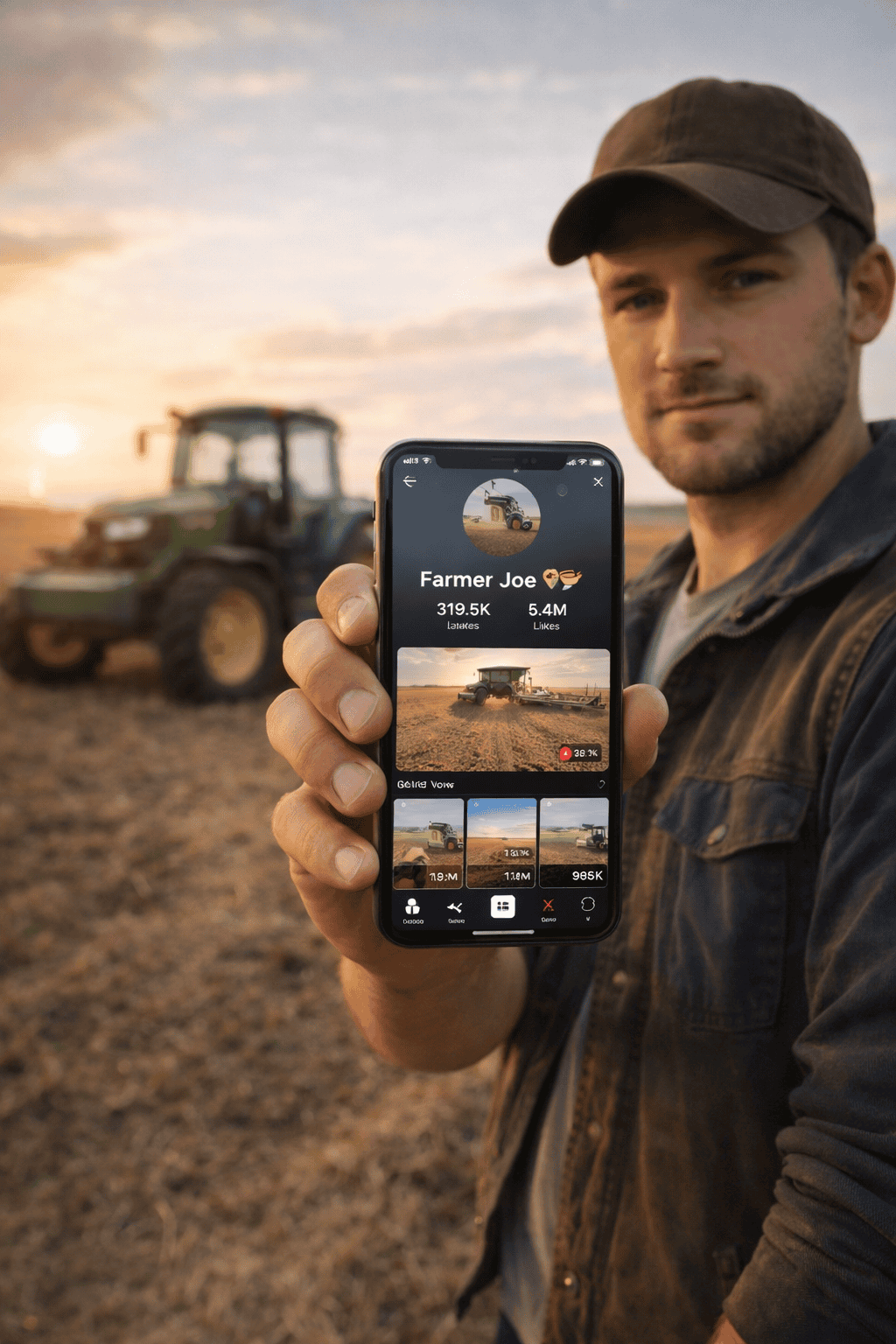
The $50 Smartphone Video That Outsold Your $10,000 Print Ad Campaign
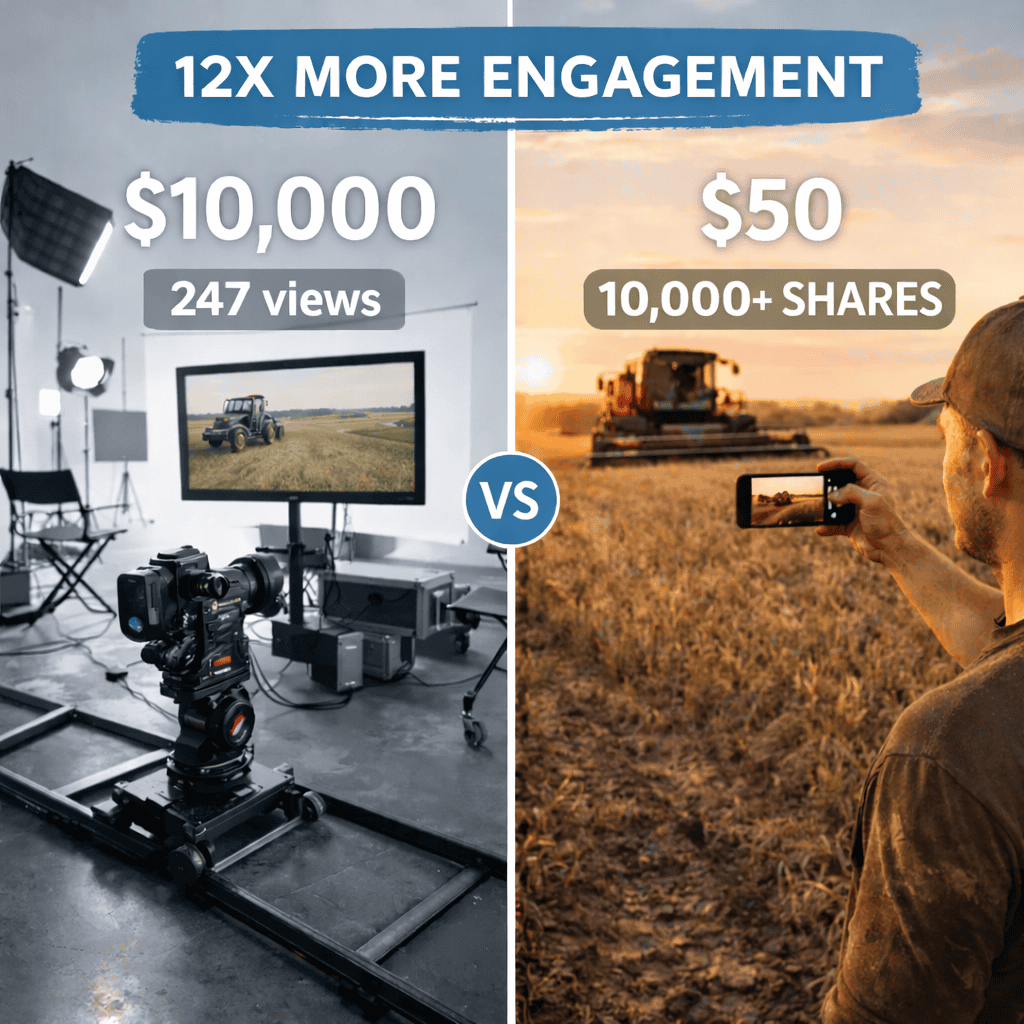
Here’s a stat that should change your entire marketing budget: video content generates 12 times more engagement than static posts in farm marketing campaigns. Not 12% more. Not double. Twelve times.
Yet most agricultural equipment dealers and input suppliers are still creating video content like it’s 2010—long, polished, corporate productions that farmers scroll past in seconds. Meanwhile, a dealer’s 60-second smartphone video showing a combine working in muddy conditions gets shared 10,000 times and generates actual sales inquiries.
According to agricultural marketing research, 74% of farmers say video is the most helpful type of content for their purchase decisions. But there’s a massive gap between “making videos” and “making videos that convert.” The difference isn’t production budget, it’s understanding what agricultural audiences actually want to watch.
Let’s fix your video marketing strategy. Here’s what’s working based off of the data from 2025.
Snap Shot
- Video content generates 12X more engagement than static posts in agricultural marketing – yet most ag businesses still prioritize print ads and static social posts that get minimal interaction
- 74% of farmers say video is the most helpful content for purchase decisions – making video the single most influential format in the ag buyer’s journey, but only if it’s authentic and practical
- Instagram Reels and TikTok engagement for ag brands rose 38% in 2024 – while long-form corporate videos continue to underperform, proving short-form authenticity beats production polish
- The average attention span for digital content is now 8 seconds – meaning your first 3 seconds determine whether 100 people or 10,000 people see your message
- Videos under 60 seconds get 5X more shares than videos over 2 minutes – but most ag companies are still producing 5-minute corporate overviews that nobody finishes watching
Why Most Agricultural Video Marketing Fails
Let’s start with brutal honesty: your current video content probably isn’t working. Here’s why:
The Corporate Trap
You hired a production company. Spent $5,000-$15,000. Got a beautifully shot 3-minute video with professional voice-over, licensed music, and sweeping drone footage of your dealership. It has 247 views on YouTube after six months, mostly from employees checking it out.
The problem? It looks like an ad. It sounds like an ad. It feels like every other corporate video farmers scroll past 100 times a day.
The Length Problem
According to engagement data, videos under 60 seconds get 5 times more shares than videos over 2 minutes. Yet agricultural companies routinely produce 5-10 minute videos trying to cram every feature, benefit, and corporate message into one piece of content.
Farmers are watching videos during lunch breaks, between fields, or while waiting for parts. They don’t have 10 minutes. They barely have 60 seconds.
The Authenticity Gap
Research shows that 81% of consumers say transparency in sourcing influences their purchasing decisions. The same applies to agricultural marketing—farmers want to see real equipment, real conditions, real results. Not studio shots and scripted testimonials.
When a video feels staged, farmers scroll. When it feels authentic, they stop, watch, save, and share.
For your business, this means: Everything you thought you knew about “professional” video content might be holding you back. The videos that perform best in agriculture in 2025 often look nothing like traditional advertising.
What Actually Works: The 7 Video Formats That Convert
Based on analysis of top-performing agricultural content across TikTok, Instagram, YouTube, and Facebook, here are the video formats driving engagement and, more importantly, sales:
1. Problem-Solution in 60 Seconds (Highest Converting)
What it is: Show a common farming problem, then demonstrate how your product/service solves it. All in under 60 seconds.
Why it works: Farmers are problem-solvers. When they see their own challenges reflected in content, they stop scrolling.
Example framework:
- 0-5 seconds: Hook showing the problem (“Spent 3 hours yesterday unclogging planters…”)
- 5-45 seconds: Show your solution in action
- 45-60 seconds: Quick result/benefit
Production level: Smartphone footage. No editing required beyond basic cuts. Authenticity matters more than polish.
For your business: Document every customer problem you solve. That’s your content library right there.
2. Side-by-Side Comparisons
What it is: Show your product/technology next to the old way of doing things or a competitor’s solution.
Why it works: Farmers are data-driven. Visual comparisons communicate value faster than any written spec sheet.
Example framework:
- Split-screen showing old vs. new technology
- Time-lapse of same task with different equipment
- Before/after results from same field
Production level: Basic phone camera with split-screen editing (free apps like CapCut can do this).
For your business: Your existing equipment trials and demos are ready-made comparison content. Just document them.
3. Customer Testimonials (But Not How You Think)
What it is: NOT a scripted customer reading talking points. Real farmers, unscripted, talking about actual results in 30-60 seconds.
Why it works: According to research, 25% of agricultural product sales are now influenced by online recommendations. Authentic testimonials build the trust that drives purchases.
Example framework:
- Ask customer one simple question: “What problem did this solve?”
- Film their 30-60 second answer
- Add text overlay with their name and farm
- Post it
Production level: iPhone video. Natural lighting. Real location. Zero staging.
For your business: Text or call your happiest customers. Ask to film a 60-second testimonial during your next visit. You’ll get 10-20 pieces of content in a month.
4. Behind-the-Scenes and Day-in-the-Life
What it is: Show what actually happens at your dealership, in your service department, at deliveries, or during installations.
Why it works: Transparency builds trust. Showing your team, process, and expertise positions you as authentic and competent.
Example framework:
- Morning at the parts counter
- Delivery day documentation
- Service tech fixing a complex problem
- Team preparing for a trade show
Production level: Raw footage. Minimal editing. These work as Instagram Stories or TikTok videos exactly as filmed.
For your business: This is the easiest content to create because you’re already doing it. Just document your normal operations.
5. Quick Tips and How-To’s
What it is: 30-60 second educational content teaching farmers something useful about equipment, maintenance, efficiency, or techniques.
Why it works: According to agricultural marketing data, 53% of marketers report that educational content yields higher ROI than traditional advertising. You’re providing value, not just pitching.
Example framework:
- “Here’s how to winterize your sprayer in 60 seconds”
- “3 signs your planter needs calibration”
- “The one thing most farmers forget during harvest prep”
Production level: Talking head or hands-on demonstration. One take. Simple text overlays for key points.
For your business: Your team has decades of expertise. Turn every service call lesson, maintenance tip, or customer question into a quick video.
6. Time-Lapse and “Satisfying” Content
What it is: Speed up long processes (planting a field, harvesting, equipment assembly) into 15-60 second time-lapses.
Why it works: It’s visually engaging, shows scale/capability, and the “satisfying” factor drives massive shares.
Example framework:
- Time-lapse of a field being planted start to finish
- Equipment delivery and setup condensed
- Harvest operation from drone perspective
Production level: Phone camera on tripod or windshield mount. Speed up in editing (free apps work fine).
For your business: Farmers love watching efficient operations. Every field demo and customer job site is potential time-lapse content.
7. Numbers and Results (Data-Driven)
What it is: Show measurable outcomes—fuel savings, time savings, yield improvements, cost reductions—in clear, visual formats.
Why it works: Farmers make purchasing decisions based on ROI. Visual proof of results shortens the sales cycle.
Example framework:
- “This precision technology saved Customer X $12,000 last season”
- “Before: 8 hours to plant 160 acres. After: 5 hours with new planter”
- “Yield map comparison: +15 bushels per acre in precision-managed zones”
Production level: Simple graphics or text overlays on relevant footage. No fancy animation needed.
For your business: Your customer success stories have numbers. Visualize them. Post them. Convert them.
The First 3 Seconds: Hook or Die
Here’s the harsh reality of 2025 digital content: the average attention span is 8 seconds, but most viewers decide whether to keep watching in just 3 seconds.
Your first 3 seconds aren’t an introduction. They’re a make-or-break moment. Here’s what works:
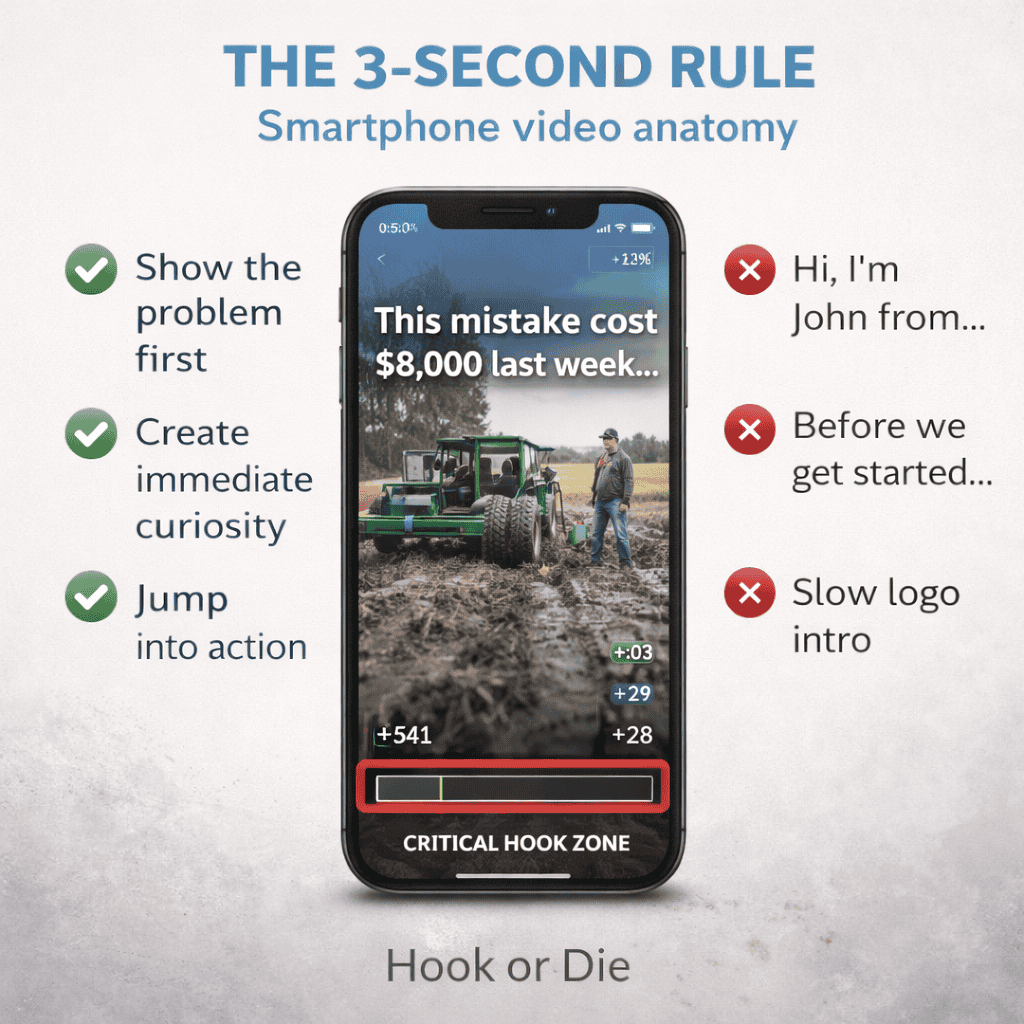
Weak Hooks (What NOT to Do):
- “Hi, I’m John from Smith Equipment and today I want to talk to you about…”
- Slow zoom on your logo with upbeat music
- Long establishing shot of your building
- “Before we get started, let me tell you about our company…”
Strong Hooks (What WORKS):
- “This mistake cost a customer $8,000 last week…” (creates immediate curiosity)
- Show the problem visually with text overlay: “Spent 6 hours yesterday…” (relatability)
- Jump right into action: Start mid-demonstration, mid-process, mid-story
- Ask a provocative question: “Why do 60% of farmers overspend on…”
- Show a surprising result first: “We cut his fuel costs by 40%. Here’s how…”
Research from social media marketing in agriculture shows that videos with text hooks in the first 3 seconds get 30% higher completion rates than videos that start with talking heads or logos.
For your business, this means: Ruthlessly edit your first 3 seconds. Every video. Every time. If those seconds don’t create curiosity, urgency, or relatability, rewrite them.
Platform-Specific Strategies That Matter
Not all video platforms are created equal. Here’s what works where:
TikTok & Instagram Reels (15-60 seconds)
What works: Raw, authentic, educational, or entertaining content. No corporate polish. Fast cuts. Text overlays. Trending sounds.
Engagement data: Instagram engagement rates for agriculture brands rose 38% in 2024, driven primarily by Reels.
What to post: Quick tips, problem-solutions, day-in-the-life, customer stories, comparison videos.
Posting frequency: 3-5 times per week minimum for algorithm favor.
YouTube (1-15 minutes)
What works: Detailed equipment reviews, how-to tutorials, customer testimonials, comparison tests, seasonal prep guides.
Why it matters: Farmers use YouTube for research before big purchases. If you’re not there with educational content, competitors are.
What to post: Longer-form content that complements your short-form videos. Think of TikTok as the teaser, YouTube as the deep dive.
Posting frequency: 1-2 times per week is sustainable and effective.
Facebook (30 seconds – 3 minutes)
What works: Community-focused content, customer stories, event coverage, longer testimonials, educational series.
Why it matters: Older demographic still very active here. High share rate in agricultural communities.
What to post: Content that encourages comments and conversation. Facebook’s algorithm prioritizes engagement.
Posting frequency: Daily if possible. Facebook rewards consistent posting.
LinkedIn (30 seconds – 2 minutes)
What works: Industry insights, thought leadership, company culture, B2B partnerships, trade show coverage.
Why it matters: Decision-makers and farm managers are active here. Great for B2B ag sales.
What to post: More polished content acceptable here. Focus on expertise and professionalism.
Posting frequency: 2-3 times per week.
For your business, this means: Create one piece of core content (customer testimonial, equipment demo, etc.) and adapt it for each platform. A 5-minute YouTube video becomes multiple 60-second TikToks becomes a LinkedIn post becomes a Facebook story series.
The Technical Basics (That Actually Matter)
You don’t need a film degree, but you do need to understand these fundamentals:
Vertical vs. Horizontal Video
- TikTok/Instagram Reels/Stories: Vertical (9:16 ratio) is mandatory
- YouTube: Horizontal (16:9) performs better for long-form
- Facebook: Either works, but square (1:1) gets higher engagement
Pro tip: Film vertically for mobile-first content. You can always crop to horizontal, but horizontal can’t become proper vertical.
Lighting
- Natural light is your friend (film outdoors or near windows)
- Avoid filming farmers with sun directly behind them (you’ll get silhouettes)
- Overcast days are actually ideal (soft, even light with no harsh shadows)
Pro tip: The “golden hour” (first hour after sunrise, last hour before sunset) makes everything look better. Use it.
Audio Quality
- Good audio matters MORE than good video quality
- External microphone for smartphones costs $20-50 and dramatically improves quality
- When filming outside, watch for wind noise (use windscreen or film strategically)
- Indoor echo? Film in smaller rooms or add soft materials (blankets, hay bales) to absorb sound
Pro tip: Test your audio first. If viewers can’t hear clearly, they won’t finish watching.
Captions and Text Overlays
- 85% of video content is watched without sound
- Add captions/text overlays to EVERY video
- Most editing apps have auto-caption features now (CapCut, Instagram, TikTok)
Pro tip: Make your videos work silently. Viewers should understand your message even with sound off.
File Formats and Upload
- Film in HD minimum (1080p)
- Most smartphone cameras default to appropriate settings
- Upload directly from your phone when possible (maintains quality)
For your business, this means: Buy a $30 smartphone tripod and $25 external microphone. That’s your entire equipment investment. Everything else is just learning by doing.
The Content Calendar That Works (30-Day Plan)
Here’s a realistic, sustainable video content calendar for agricultural businesses:
Week 1: Foundation
Monday: Customer testimonial (60 sec)
Wednesday: Quick tip/how-to (30-45 sec)
Friday: Behind-the-scenes (60 sec)
Week 2: Product Focus
Monday: Product demonstration (60 sec)
Wednesday: Problem-solution video (60 sec)
Friday: Customer success story with results/numbers (45 sec)
Week 3: Educational
Monday: Common mistake to avoid (45 sec)
Wednesday: Time-lapse of operation (30 sec)
Friday: Side-by-side comparison (60 sec)
Week 4: Community & Engagement
Monday: Team spotlight or day-in-the-life (60 sec)
Wednesday: Seasonal tip or prep advice (45 sec)
Friday: Customer shout-out or appreciation (30 sec)
For your business, this means: This calendar creates 12 videos per month, manageable for even small teams. Film several videos in one day (batching) to stay ahead of the schedule.
The Metrics That Actually Matter
Stop obsessing over views. Here are the metrics that correlate with business results:
1. Watch Time / Completion Rate
If people watch your entire video, the algorithm shows it to more people. Aim for 50%+ completion rate.
2. Saves and Shares
These indicate valuable content worth revisiting or showing others. High save/share rate = content that builds trust.
3. Comments and Questions
Comments trigger conversation, which boosts algorithmic reach. More importantly, comments often reveal customer pain points and questions your sales team should address.
4. Profile Visits
After watching your video, did viewers click through to learn more about your business? This indicates purchase consideration.
5. Website Traffic from Social
Use UTM tracking or platform analytics to see how many people go from video to website. This is your real conversion metric.
For your business, this means: Track these metrics weekly. Double down on content types that drive profile visits and website traffic. Those correlate directly with sales opportunities.
Common Objections (And the Reality Check)
Let’s address why ag businesses hesitate to create video content:
“We don’t have time”
Reality: You spent 8 hours at a trade show last month talking to 50 people. A 60-second video can reach 5,000. Time isn’t the issue—prioritization is.
“We’re not good on camera”
Reality: The best-performing ag videos aren’t polished presentations. They’re real people having real conversations. Authenticity beats eloquence every time.
“We need professional equipment”
Reality: Your smartphone camera is 1080p or 4K. That’s professional quality. A $30 tripod and $25 microphone complete your setup. You’re ready.
“We don’t know what to film”
Reality: Every customer question, every service call, every equipment delivery, every seasonal prep task, that’s all content. You’re already doing it; just document it.
“What if it doesn’t look as good as competitors’ content?”
Reality: Research shows 67% of small farms now use social media, and most successful agricultural content looks homemade because it IS homemade. Stop competing on production value. Compete on authenticity and value.
For your business, this means: The biggest barrier is psychological. Start filming. Your first 10 videos will be rough. Your next 10 will be better. By video 30, you’ll have found your voice and style.
The ROI Reality: What to Expect
Let’s set realistic expectations about video marketing ROI in agriculture:
Short-Term (First 90 Days)
- Build content library (30-40 videos)
- Establish posting consistency
- Learn what resonates with your audience
- Modest follower growth
- Increased website traffic
Medium-Term (3-6 Months)
- Some videos start reaching broader audiences
- Customer inquiries mentioning “saw you on TikTok/Instagram”
- Improved engagement across all platforms
- Search traffic improvement (video content helps SEO)
- Sales team reports easier conversations (customers pre-educated)
Long-Term (6-12 Months)
- Measurable sales attributed to video content
- Reduced marketing costs per acquisition
- Brand recognition in your market area
- Recruiting advantages (showing company culture attracts employees)
- Industry partnerships and collaboration opportunities
According to agricultural marketing research, 53% of ag marketers report that content marketing yields higher ROI than traditional marketing strategies. But the key word is “strategies”, consistent, long-term execution, not one viral video.
For your business, this means: Commit to 6-12 months of consistent posting before evaluating success. Video marketing is compound interest, early efforts may feel low-reward, but consistency builds exponentially.
Real Success Stories: What Works in Practice
Case Study 1: Rural Equipment Dealer
Small dealership in Nebraska started posting 3x weekly short videos showing equipment deliveries, customer testimonials, and service tips. After 6 months:
- 4,200 followers across TikTok and Instagram
- 3 direct sales attributed to customers finding them on social media
- Service department reports customers arrive better informed
- Recruiting improved (local ag tech graduates found them online)
Case Study 2: Input Supplier
Regional ag input supplier created weekly 60-second videos explaining agronomic concepts, product comparisons, and application timing. Results at 8 months:
- 8,500 TikTok followers
- Website traffic from social increased 340%
- Email list grew by 600 contacts
- Sales team closes deals faster (customers pre-educated on products)
Case Study 3: Precision Ag Provider
Technology provider filmed customer results—yield maps, savings data, efficiency gains—in simple 45-second videos. After 4 months:
- Videos shared by customers to their own networks (free amplification)
- Demo requests increased 45%
- Sales cycle shortened by an average of 3 weeks
- Industry reputation improved (seen as transparent about results)
For your business, this means: These aren’t mega-influencers with production teams. They’re regular ag businesses that committed to consistent, authentic video content. Results like these are replicable with effort and consistency.
The Action Plan: Start This Week
Here’s your step-by-step plan to launch video marketing that works:
This Week:
- Download TikTok, Instagram, and CapCut (free editing app) on your phone
- Buy a smartphone tripod ($20-30 on Amazon)
- Follow 20 agricultural accounts to understand the style and format
- Film your first 3 videos (don’t overthink—just document something you’re already doing)
- Post them
Next 30 Days:
- Commit to 3 videos per week (Mon/Wed/Fri)
- Use the content calendar above
- Respond to every comment
- Track which videos perform best
- Adjust based on what your audience engages with
Next 90 Days:
- Build to 40+ videos total
- Identify your top 5 performing video types
- Create more of what works
- Experiment with one new format weekly
- Start repurposing top performers to other platforms
For your business, this means: You could have 50 pieces of video content live within 90 days. That’s 50 opportunities for customers to find you, trust you, and choose you over competitors who are still relying on print ads and static posts.
The Bottom Line
Video content generates 12 times more engagement than static posts. 74% of farmers say video is the most helpful content for purchase decisions. Instagram engagement for ag brands rose 38% in 2024. These aren’t predictions—this is the current reality of agricultural marketing.
The ag businesses winning with video marketing in 2025 aren’t the ones with the biggest budgets or the fanciest equipment. They’re the ones who showed up consistently with authentic, valuable content that farmers actually want to watch.
Your smartphone camera is professional quality. Your team’s expertise is valuable content. Your daily operations are interesting to your customers. You have everything you need to start except one thing: the decision to start.
12X engagement is waiting. The only question is whether you’ll create the content or watch your competitors capture that attention.
What are you going to film this week?
Sources and Further Reading
- Agricultural Marketing Statistics 2025 – ZipDo Education Reports, May 30, 2025
- “TOP 20 FARM MARKETING STATISTICS 2025” – Amra And Elma LLC, September 16, 2025
- Available at: https://www.amraandelma.com/farm-marketing-statistics/
- “Social Media Marketing In Agriculture: Top 7 Strategies” – Farmonaut, June 30, 2025
- “Digital Marketing Strategies For Agricultural Products 2025” – Farmonaut, July 5, 2025
- “FarmTok & Social Media Impact On Modern Farmers” – Farmonaut, June 18, 2025
- Agricultural video engagement research – Multiple industry marketing studies 2024-2025
- Consumer transparency research – Agricultural marketing trend analysis 2025
- Social media platform analytics – Instagram, TikTok, YouTube agricultural engagement data 2024-2025
About Fastline Marketing Group: For nearly 50 years, Fastline Marketing Group has been the trusted partner for agricultural businesses looking to connect with farmers and ranchers. Our video marketing services help you create authentic, engaging content that converts viewers into customers. From strategy to production to distribution, we handle the details so you can focus on running your business.
Ready to start creating video content that actually gets watched? Contact Us Here!
