
Marketing professionals know the pitch: “our websites deliver results.” But when it’s time to ask for budget, the numbers get fuzzy fast. Whether you’re advocating for a site rebuild to your CFO or evaluating agency proposals, you need real figures, not vague ranges designed to get you on a sales call. This guide lays out honest cost benchmarks, what drives pricing up or down, and how to protect your organization from common budget traps.
What This Guide Covers
- The core factors that determine website development cost
- Realistic development tiers for mid-market businesses
- What “custom design” actually means and what it costs
- E-commerce and online store pricing
- Dedicated product or service catalog builds
- Hosting, security, and annual maintenance
- Red flags to identify before signing a contract
- Total cost of ownership: what to actually budget
Website Development Costs for Mid-Market Organizations
Not all websites are created equal and neither are their price tags. The complexity of your site should match the complexity of your business. A company with multiple product lines, a field sales team, and a need to generate inbound leads online has different requirements than a five-page brochure site.
Here’s how development costs generally break down for medium-sized businesses:
| Website Type | Typical Cost Range |
| Foundational site (6–10 pages, mobile-optimized) | $4,000 – $8,000 |
| Mid-tier site with integrations (CRM, forms, analytics) | $8,000 – $20,000 |
| Full custom build with advanced functionality | $20,000 and up |
These ranges reflect what competent agencies actually charge for real work. If a quote comes in dramatically below these numbers, ask why. Budget-tier builds often create technical debt that costs more to undo than to have done it right the first time.
The Real Cost of Custom Design
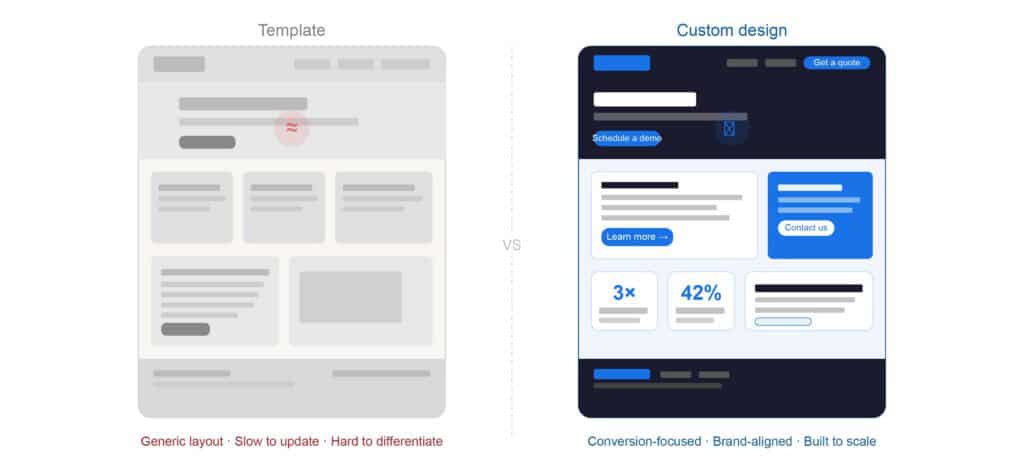
Custom design is one of the most misunderstood line items in a website proposal. It does not mean “pretty” it means built to convert. A well-designed site translates your brand positioning into a digital experience that moves visitors toward action: a form fill, a call, a purchase.
Template-based websites can look fine at launch and cost less upfront. But they typically limit your ability to differentiate, create bottlenecks when you want to update content, and often under-perform on load speed and mobile responsiveness.
Custom design for a mid-market business typically adds $3,500 to $7,500 on top of development costs. That investment covers:
- Brand-aligned visual systems (color, typography, imagery guidelines)
- Layouts built around your specific conversion goals and user journeys
- Mobile-first design that performs across device types
- Scalable page templates your team can manage without a developer
A word of caution: if a proposal promises “full custom design” for under $1,000, you’re likely getting a pre-built theme with your logo dropped in. That’s a legitimate option for some use cases just know what you’re buying.
E-Commerce Pricing for Business Websites
Adding transactional capability to your website is no longer just for B2C retailers. Mid-market companies are increasingly selling products, subscriptions, services, and digital goods online and the infrastructure to do it right requires real investment.
E-commerce functionality means product catalogs, a shopping cart, payment processing, inventory management, and customer account systems. When it’s built well, it scales with your business. When it’s rushed, it creates customer experience problems that directly affect revenue.
| E-Commerce Scope | Estimated Build Cost |
| Basic storefront (under 100 SKUs) | $3,000 – $7,000 |
| Mid-range catalog (100–500 products) | $7,000 – $15,000 |
| Full-scale store with live inventory sync | $15,000+ |
Remember to factor in recurring costs: platform licensing fees, payment processing fees (typically 2.5–3% per transaction), and ongoing catalog management. These are operational costs, not one-time expenses they belong in your annual marketing budget.
Not every organization needs full e-commerce from day one. If your sales process involves consultation before purchase, a “request a quote” or “schedule a demo” flow may deliver better conversion for a fraction of the cost.
Building a Dedicated Product or Service Catalog
A product or service catalog is a specific kind of build that deserves its own planning conversation. For businesses with complex offerings multiple product lines, SKU-level detail, compatibility filters, or specification sheets a catalog is more than a product page. It’s a digital sales tool.
Done well, a catalog reduces the load on your sales team by giving buyers the information they need to self-qualify. It also drives SEO value when individual product and category pages are properly optimized.
Key functional requirements for a business-grade catalog typically include:
- Faceted search and filter by category, specification, or application
- SKU-level detail pages with downloadable documentation
- Inventory or availability status where relevant
- Integration with your existing ERP or inventory management system
- Optional quoting or sample request workflows
Dedicated catalog builds for mid-market organizations typically start around $10,000 and can reach $25,000 or more when deep system integration is involved. The ROI case is usually straightforward: fewer calls to your sales team, shorter sales cycles, and better-qualified leads.
Annual Maintenance: The Budget Line That Gets Forgotten
The launch is not the finish line it’s the starting line. A website that isn’t actively maintained degrades. Page speed slows. Security vulnerabilities accumulate. Plugins fall out of date and break functionality. Content goes stale. For marketing teams, an unmaintained website quietly undermines every campaign you run.
Annual website maintenance for a mid-market organization generally covers:
- Web hosting and CDN (content delivery network) infrastructure
- SSL certificate management and security monitoring
- Core software, CMS, and plugin updates
- Regular backups and disaster recovery
- Ongoing content updates and seasonal changes
- Performance monitoring and uptime alerts
| Maintenance Level | Annual Cost Range |
| Basic hosting and security maintenance | $800 – $2,400/year |
| Standard plan with content updates | $2,400 – $6,000/year |
| Fully managed plan with proactive support | $6,000+/year |
Many agencies offer maintenance as a monthly retainer. This works well when the scope is clearly defined in writing. Before signing, ask specifically what is included, what triggers additional charges, and what the response time SLA looks like.
Red Flags to Catch Before You Sign
Marketing leaders are often the people most equipped to spot a bad agency proposal and the ones most likely to be held accountable when a site under delivers. Watch for these warning signs:
You won’t own the website. Some vendors build on proprietary platforms where the files live on their servers. If you cancel, you lose the site. Always confirm that you retain ownership of the domain, the code, and all content.
Vague scope documents. A proposal without a defined page count, feature list, and milestone schedule is an open invitation for scope creep and unexpected invoices. Get specifics in writing before work begins.
The cheapest quote is rarely the best deal. A $1,500 website that doesn’t rank, doesn’t convert, and requires a full rebuild in 18 months will cost your organization more than a $10,000 site built to last.
No post-launch plan. If the agency has nothing to offer after launch day, you’ll be managing updates and security in-house or scrambling to find support when something breaks.
No experience in your industry. A generalist developer can build a website. An agency with industry-specific experience understands your buyer’s journey, your competitive context, and the integrations you’ll actually need.
What to Budget: A Total Cost of Ownership View
Marketing and finance teams often approach website spend differently. One views it as a campaign asset. The other views it as a capital expenditure with a depreciation curve. Both perspectives are right and a good budget accounts for both.
Here’s a realistic total cost of ownership framework for planning purposes:
| Website Investment Level | Estimated Total (Year 1 + Annual) |
| Foundational business site | $5,000 – $10,000 build + $1,500–$3,000/year |
| Mid-range site with integrations | $10,000 – $25,000 build + $3,000–$6,000/year |
| Full site with e-commerce and catalog | $25,000 – $50,000+ build + $5,000+/year |
The right budget is the one aligned to your business objectives, not the one that passes the lowest bar of approval. A website that generates leads, supports your sales team, and reflects your brand positioning is a revenue-generating asset not a cost center.
Ready to Build the Business Case?
Fastline Marketing Group works with marketing teams and growing businesses to build websites that perform not just websites that launch. We understand that you’re accountable for results, and we build accordingly.
Call us at (877) 338-1209 or visit fastlinemarketinggroup.com to talk through your project and get an honest, itemized proposal.
