
How you market your company tells people who you are, what you do, and why they should choose you, and it does all of that before anyone ever speaks to a member of your team. That’s not a minor detail. That’s your first impression, your handshake, your opening argument. And for most businesses, it’s largely operating on autopilot.
The hard truth is this: your marketing is always making an impression. The only question worth asking is whether that impression is intentional.
Need help figuring out your marketing click here > FREE MARKETING CONSULTATION
Blog in a Snapshot
- Every marketing touch-point shapes brand perception, whether you plan it or not.
- The intent-impact gap is the disconnect between what your brand means to say and what audiences hear.
- Closing that gap requires honest data about how your brand is truly perceived, not just how you hope it is.
- Brands like Nike and Kroger succeed not by accident, but because their intent is clear, consistent, and emotionally resonant across every channel.
- Intentional marketing is a business strategy with measurable outcomes, not just a creative exercise.
- The path forward starts with an honest audit of what your audience is taking in.
Every Touch-point Is a Data Point
Consider how many surfaces your brand occupies. Your website. Your social media profiles. Paid search and display ads. Email campaigns. Even a printed mailer or a trade show banner. Each one is a moment of contact, a touch-point, and each one contributes to a cumulative picture of your brand in the minds of your audience.
Research in consumer behavior consistently shows that brand perception is rarely formed by a single interaction. It’s built through repetition, consistency, and emotional resonance across multiple encounters [1]. When those touch-points align, they reinforce each other. When they don’t, they create friction, and friction erodes trust.
This is why the question isn’t “Are we doing marketing?” Almost every organization is. The question is: Are your touch-points telling a coherent, intentional story?
The Intent-Impact Gap
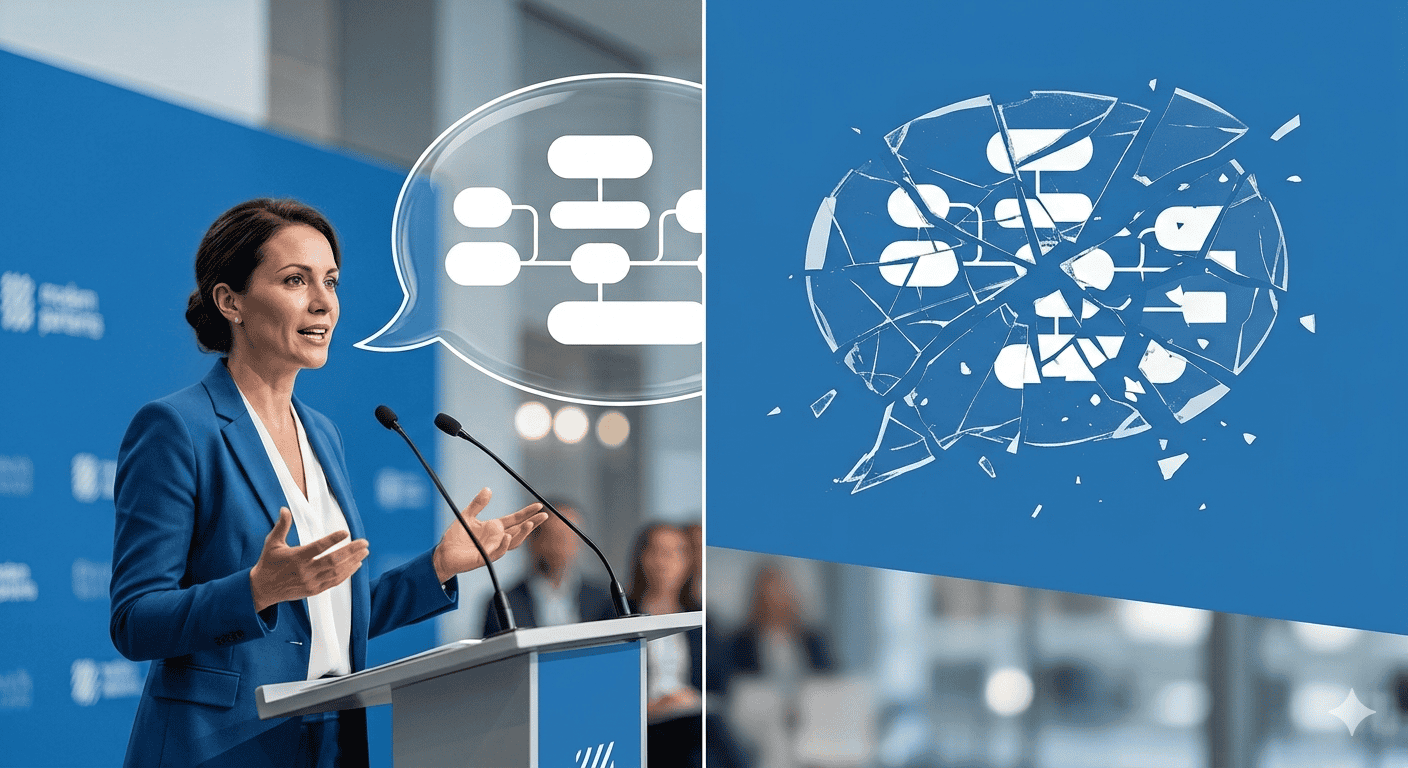
Here’s where many organizations, even well-resourced ones, get it wrong. There is often a significant gap between what a brand intends to communicate and what its audience receives.
Your team writes copy that feels direct and confident. Your audience reads it as aggressive or impersonal. You invest in sleek, modern design. Customers find it cold and difficult to navigate. You position your company as a premium solution. Prospects assume you’re out of their budget and never inquire.
None of these failures are about effort. They’re about alignment. And closing that gap begins with one discipline that many organizations under invest in: genuinely understanding how your audience sees you.
This isn’t a soft, feel-good exercise. It’s a strategic intelligence function. When you have clear, honest data about how your brand is perceived, not how you hope it’s perceived, you can make sharper decisions about messaging, positioning, creative direction, and channel strategy. You stop guessing and start engineering.
Intent as Business Strategy
Leading with intent is not a branding philosophy. It is a business strategy with measurable outcomes.
When there is a clear, documented purpose behind every message, every visual choice, and every campaign decision, your marketing stops being noise and starts becoming a conversation. It attracts the right customers, repels the wrong ones (a feature, not a bug), and builds the kind of brand equity that compounds over time.
Consider Nike. The company doesn’t just sell athletic footwear and apparel. It sells an identity. By consistently aligning with high-profile athletes like LeBron James, Serena Williams, and Colin Kaepernick, Nike has positioned itself as a brand that embodies competitive excellence and, more recently, moral courage [2]. Their iconic “Just Do It” tagline is not a product claim. It’s a worldview. And that worldview attracts a specific, fiercely loyal customer who sees something of themselves reflected in the brand. Every media dollar Nike spends reinforces that intent. The impact is a brand valued at approximately $29.4 billion as of 2025 [3].

Now consider a very different example: Kroger. Their marketing doesn’t chase aspiration in the Nike sense. Instead, it consistently signals something equally powerful to their audience: accessibility and value without compromise. Built around their “Fresh for Everyone” brand positioning [4], Kroger’s messaging centers on fresh produce, affordable prices, and dependable quality. For budget-conscious households that don’t want to sacrifice on what ends up on the dinner table, Kroger’s messaging lands as a form of respect. We see you, and we’ve built this for you. That emotional connection, built on practicality rather than prestige, drives loyalty just as effectively as Nike’s emotional appeals, but for a completely different set of values.
Both brands succeed because their intent is legible. Their audiences don’t have to guess what these companies stand for. The marketing makes it clear, repeatedly, across every channel.
Marketing That Moves People
At its core, effective marketing is about two things: evoking emotions and shifting perspectives. People do not make purchasing decisions in a purely rational vacuum. They buy how something makes them feel. They buy into narratives. They choose brands that appear to understand their lives, their problems, and their aspirations.
This is why the emotional experience your brand creates is not secondary to your business strategy. It is your business strategy, expressed outward. When the intent behind your brand aligns with the emotional experience your audience has, the economics change. Marketing stops being a cost center and starts functioning as a growth engine.
But that alignment doesn’t happen by accident. It requires honest diagnosis, disciplined strategy, and the willingness to close the gap between what you think you’re saying and what people are hearing.
Where to Start
Take an audit of your marketing, not just what you’re putting out, but what your audience is taking in. Talk to your customers. Survey prospects who didn’t convert. Review your analytics not just for clicks, but for patterns that suggest confusion or misalignment.
Ask the fundamental question: Is the intent behind your brand coming through?
If the answer is uncertain, or worse, no, that’s not a failure. That’s a starting point. The gap between intent and impact is one of the most solvable problems in business, and closing it is one of the highest-return investments your organization can make.
Ready to assess the gap in your own marketing? Let’s start with a conversation about where your brand stands today and where it could be. Click here for a free consultation.
Sources
- Blue Monarch Group. “Perception vs. Reality: The Transformative Power of Branding on Consumer Decisions.” April 1, 2024. https://bluemonarchgroup.com/blog/perception-vs-reality-the-transformative-power-of-branding-on-consumer-decisions/
- Wikipedia. “Nike, Inc.” Accessed March 2026. https://en.wikipedia.org/wiki/Nike,_Inc.
- Brand Finance via Statista. “Brand Value of the Sports Company Nike Worldwide from 2016 to 2025.” January 17, 2025. https://www.statista.com/statistics/632210/nike-brand-value/
- Buildd.co. “Kroger Marketing Strategy: Navigating Retail Innovation and Customer Loyalty.” Accessed March 2026. https://buildd.co/marketing/kroger-marketing-strategy/
Frequently Asked Questions
What is the Intent vs. Impact gap in marketing? The Intent vs. Impact gap is the disconnect between what your brand intends to communicate and what your audience actually receives. It happens when messaging, visuals, or tone are interpreted differently than planned, often without the business ever realizing it.
How do I know if my brand has an Intent vs. Impact problem? Common signs include low conversion rates despite strong traffic, customer feedback that doesn’t match your brand values, high bounce rates on key pages, or prospects who misunderstand your pricing or positioning. If people consistently misread what you offer, the gap is likely present.
Is this a problem only small businesses face? Not at all. Even well-resourced organizations with dedicated marketing teams experience this. The gap tends to grow when companies scale quickly, enter new markets, or rely too heavily on internal assumptions about how their audience thinks and behaves.
Where do I start if I want to close the gap? Start with listening. Customer interviews, prospect surveys, and a honest audit of your existing marketing materials are the most direct path to understanding how your brand is actually landing. The goal is to replace assumptions with real audience data.
How often should a business reassess its brand messaging? At minimum, annually. However, any significant business change a new product, a new market, a leadership shift, or a major industry development warrants a fresh look at whether your messaging still reflects your intent and resonates with your audience.
What is the difference between brand intent and brand perception? Brand intent is what you deliberately try to communicate through your marketing. Brand perception is how your audience actually experiences and interprets your brand. The goal of intentional marketing is to close the distance between the two as much as possible.
