
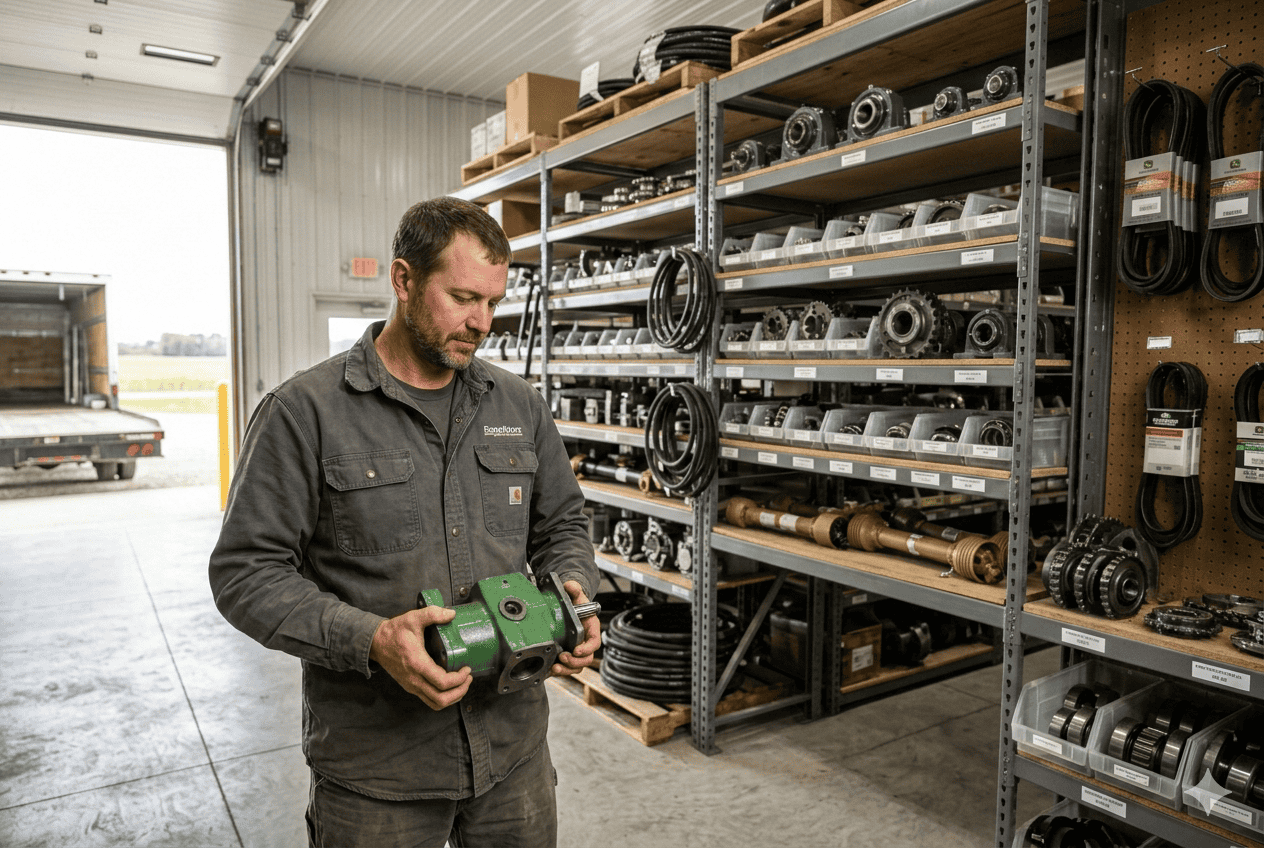
You’ve got parts. Someone out there needs them. The problem isn’t supply, it’s visibility.
Every year, ag dealers sit on shelves full of used tractor components, aging combine headers, and orphaned attachments that are worth real money to the right buyer. But without the right platform, the right photos, and the right price, those parts collect dust instead of dollars.
The good news? Selling farm parts online has never been more accessible. Whether you’re clearing out warehouse overflow or building a full-time parts resale operation, this guide walks you through exactly what you need to know, from picking the right platform to getting a 500-pound auger head shipped across three states without losing your mind.
Let’s get into it.
Blog Snapshot: What You’ll Learn
- The best platforms to sell used and new farm parts online, including Fastline.com, Tractor House, Machinery Trader, and Facebook Marketplace
- Photography tips that actually move inventory (hint: lighting matters more than your camera)
- How to price farm parts competitively without leaving money on the table
- Shipping strategies for bulky ag components without getting killed on freight costs
- Marketing your parts listings so serious buyers actually find them
- How to value old tractor parts for resale the right way
1. Best Platforms to Sell Farm Parts Online
Not all platforms are built the same. Where you list determines who sees it and who buys it. Here’s what works for ag dealers with serious parts inventory.
Fastline.com
If you’re selling ag parts to buyers who are actively shopping not just browsing Fastline.com is built for you. With 20–25 million annual website views from farmers and dealers looking for equipment and parts, your listing lands in front of people ready to spend money.
Unlike general marketplaces, Fastline is ag-specific. That means your John Deere 7000 planter row units aren’t buried under listings for vintage lamps and used bicycles. The audience is targeted. The buyers are real. And the platform is built to handle everything from small consumables to major assemblies.
Fastline.com also connects to broader marketing infrastructure so your parts get visibility through SEO, email, and digital advertising that general platforms simply don’t offer.
Fastline.com is part of Fastline Marketing Group, a full service marketing company that specializes in agriculture and construction industry for both business to business and business to customer marketing. It’s a one spot shop for moving your equipment online.
Tractor House & Machinery Trader
Tractor House and Machinery Trader are go-to platforms for dealers with larger, higher-value parts and components. These sites attract serious buyers people who already know what they’re looking for and are ready to negotiate or purchase outright.
They work especially well for OEM parts, attachments, and components for well-known brands like John Deere, Case IH, New Holland, and AGCO. Listings tend to perform better when you include specific model compatibility details and condition grades.
Facebook Marketplace
Don’t sleep on Facebook Marketplace. Especially for regional sales where a buyer can pick up locally. It’s free to list, easy to use, and the reach in rural agricultural communities is surprisingly strong.
Facebook works best for lower-cost parts, odd lots, and items where local pickup removes the shipping headache entirely. Join relevant Facebook Groups for farm equipment resale in your state or region to extend your reach even further.
Check out Fastline Marketplace Lister it makes adding your inventory to Facebook Marketplace a breeze.
A Note on Platform Strategy
The dealers making the most money aren’t picking one platform they’re cross-listing. Post the same part on two or three platforms and let the buyers find you. Just make sure your inventory management is tight so you’re not selling the same part twice.
2. How to Photograph Farm Parts for Online Sales
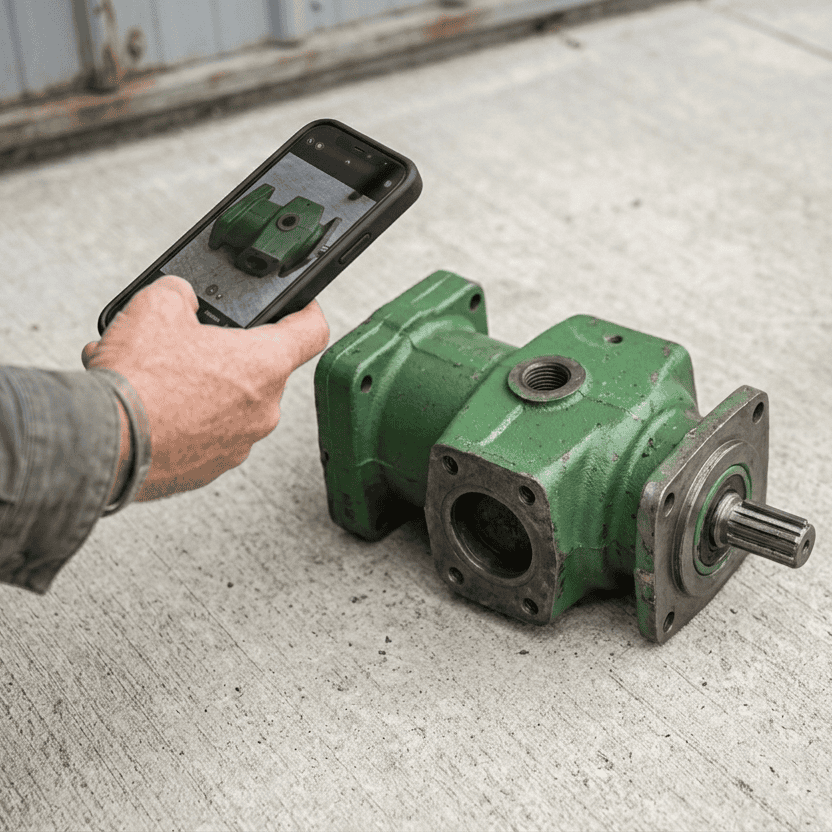
Bad photos kill good listings. A buyer who can’t clearly see what they’re buying will skip your post and find someone else’s. Here’s how to take photos that actually sell.
The Basics That Most People Skip
- Clean the part first. A quick wipe-down removes grime and signals to buyers that you take care of your inventory.
- Use natural light. Park it outside on an overcast day. Harsh sun creates shadows. Overcast skies act like a giant softbox.
- Shoot against a clean background. A concrete floor or green grass beats a cluttered shop every time.
- Take 8–12 photos minimum. Buyers want to see every angle: top, bottom, sides, mounting points, any wear or damage.
- Close-up shots matter. Get tight on part numbers, serial tags, casting marks, and any visible wear. This builds trust and reduces back-and-forth questions.
What to Photograph on Specific Parts
- Hydraulic cylinders: both ends, the rod, any pitting or scoring
- Gearboxes: input/output shafts, housing condition, any leaks or cracks
- Sheet metal: every panel, documenting dents and rust honestly
- Electronic components: the connector, the housing, and any visible damage
- Headers and attachments: full front view, rear view, and all knife/guard/tooth areas
Pro tip: A $40 ring light from Amazon transforms your shop photos. That’s a small investment against a part that might sell for $800.
3. Pricing Strategies for Farm Parts
Price too high and it sits. Price too low and you leave money on the table. Here’s how to find the sweet spot.
Do Your Research First
Before you post anything, spend 15 minutes looking at what comparable parts have actually sold for not just what they’re listed at. Active listings tell you nothing. Sold listings tell you everything.
- Search completed listings on eBay for sold prices
- Check Tractor House and Machinery Trader for current market rates on larger items
- Search Facebook Marketplace for regional pricing trends
- Check the OEM list price used parts typically sell for 30–60% of new
Condition-Based Pricing Framework
- New/Unused (OEM or aftermarket): 75–90% of list price
- Good Used (tested, ready to install): 45–65% of new cost
- Fair (functional but worn): 20–40% of new cost
- For parts/rebuilding: 10–20% of new cost
Valuing Old Tractor Parts for Resale
Vintage and antique tractor parts are a different animal. Demand is driven by restoration hobbyists and collectors, not working farmers and prices can be surprisingly strong for the right pieces.
- Check collector forums like Yesterday’s Tractors and AllisChalmers.com for market interest
- Rare parts for low-production models (Oliver, Minneapolis Moline, early Farmall) often command premiums
- Cast iron parts in good condition especially NOS (new old stock) can bring significant money
- When in doubt, post it on multiple platforms and let the market tell you what it’s worth
The ‘Price to Move’ Mindset
Inventory that sits costs you money. Storage space, insurance, your time managing inquiries it all adds up. If something has been listed for 60 days with no bites, cut the price 15–20%. A sold part at $200 beats an unsold part at $250 every single time.
4. Shipping Large Agricultural Parts Cheaply
Shipping is where a lot of ag parts deals fall apart. Buyers get sticker shock. Sellers lose sales. Here’s how to handle freight without turning it into a nightmare.
Know Your Options by Weight Class
- Under 70 lbs: UPS or FedEx Ground is usually cheapest. Get quotes from both.
- 70–150 lbs: Start comparing UPS Freight, FedEx Freight, and regional carriers.
- Over 150 lbs / oversized: You’re in LTL (Less Than Truckload) territory. uShip, FreightQuote, and Estes(Freightrun) are good starting points.
Freight Tips That Save Real Money
- Get a freight quote before you post the listing and include it in the price or list it clearly
- Use uShip.com for oversized items carriers compete for your load, driving prices down
- Palletize anything over 50 lbs. It protects the part and freight companies handle it better
- Build your freight cost into the listing price or offer ‘buyer arranges freight’ to eliminate the headache entirely
- If you’re shipping multiple items to the same buyer, consolidate one pallet beats three separate shipments
- For truly massive items (complete engines, large hydraulic pumps, header assemblies), local pickup with a fee is completely acceptable and often preferred by buyers
Packing for Agricultural Parts
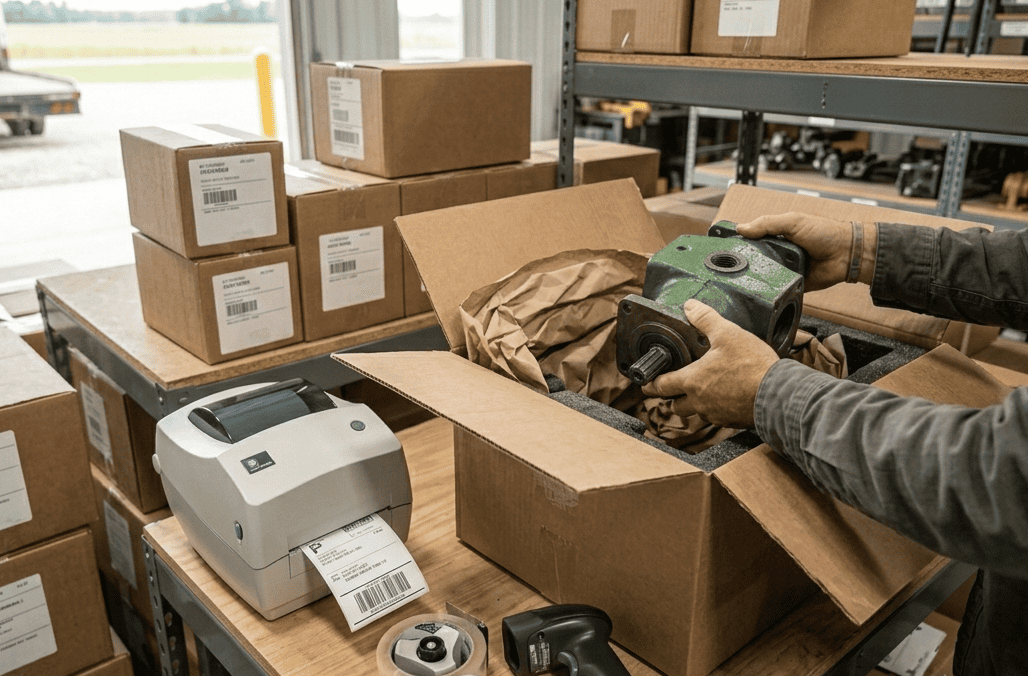
Agricultural parts are often oddly shaped, heavy, and sharp. Bad packing leads to damage claims and refund headaches.
- Wrap sharp edges with cardboard and foam before boxing
- Fill void space a part rattling around in an oversized box is a broken part
- Double-box anything fragile or electronic
- Photograph your packaging before sealing this protects you in damage disputes
5. Marketing Strategies for Farm Parts Listings
Getting listed is just the start. Getting found takes a bit of strategy.
Write Listings That Buyers (and Search Engines) Can Find
Your listing title and description are your marketing. Be specific:
- Bad: “Tractor Part – Good Condition”
- Good: “John Deere 7800 MFWD Front Axle Assembly – Low Hours, Ready to Install”
Include the brand, model compatibility, part number if known, condition, and any key measurements. The buyer searching “JD 7800 front axle” needs to find you. Not your competitor.
Cross-Post and Cross-Promote
- List on 2–3 platforms simultaneously
- Share listings in relevant Facebook Groups (many have active ag parts communities with thousands of members)
- If you have an email list of past customers, a monthly ‘parts available’ email is cheap and effective
- Consider a basic Google Business Profile it’s free and adds local search visibility
Build Your Reputation as a Reliable Parts Seller
Online parts buyers are cautious. They’ve been burned before. Trust signals matter:
- Respond to inquiries within a few hours slow response kills deals
- Be honest about condition. ‘Good used’ means something different to everyone describe it accurately
- Offer returns on misidentified parts (within reason) this removes buyer hesitation
- Collect reviews on whatever platform you use. Five-star feedback is your best marketing
Ready to Move Your Parts Inventory?
You’ve got the parts. Now you’ve got the playbook. Whether you’re cross-listing on three platforms, dialing in your freight strategy, or trying to figure out what that old Minneapolis Moline hydraulic pump is worth the buyers are out there waiting.
At Fastline Marketing Group, we help ag dealers get serious about their online presence. From listing your inventory on the right platforms to building the kind of digital footprint that keeps buyers coming back, we make the marketing side simple so you can focus on the business side.
Have questions or want to talk through how to grow your parts business online? Contact us here we’d love to help.
Credible Sources & Further Reading
- Fastline Marketplace – https://www.fastline.com – Ag-specific marketplace for equipment and parts with 20–25M annual views
- TractorHouse – https://www.tractorhouse.com – Dealer-focused listings for farm equipment and components
- MachineryTrader – https://www.machinerytrader.com – Broad agricultural and construction equipment marketplace
- uShip – https://www.uship.com – Freight bidding platform ideal for oversized agricultural shipments
- FreightQuote by C.H. Robinson – https://www.freightquote.com – LTL freight comparison tool for commercial shipments
- Yesterday’s Tractors – https://www.ytmag.com – Collector and restoration community for antique and vintage tractors useful for valuing old parts
- eBay Completed Listings – https://www.ebay.com – Use ‘Sold Listings’ filter to benchmark real market prices for used farm parts
- USDA National Agricultural Statistics Service (NASS) – https://www.nass.usda.gov – Authoritative source for U.S. farm equipment statistics and industry data
Frequently Asked Questions
Q: What is the best platform to sell used farm parts online?
A: It depends on your inventory and audience. Fastline.com is ideal for ag dealers targeting serious equipment buyers. Tractor House and Machinery Trader work well for higher-value components. Facebook Marketplace is great for regional sales and smaller parts where local pickup is an option. Many successful sellers cross-list across all three.
Q: How do I price used farm parts for resale?
A: Research comparable sold listings (not just active ones) on eBay, Tractor House, and Facebook Marketplace. A general framework: new/unused parts sell for 75–90% of list price, good used parts for 45–65%, fair/worn parts for 20–40%, and parts-only condition for 10–20%. Always factor in shipping costs before finalizing your price.
Q: How do I ship large agricultural parts cheaply?
A: Parts under 70 lbs ship best via UPS or FedEx Ground. For 70–150 lbs, compare freight carriers. For anything heavier or oversized, use a freight bidding platform like uShip.com where carriers compete on price. Palletizing your shipment and consolidating multiple items can significantly reduce per-unit freight costs.
Q: How many photos should I include in a farm parts listing?
A: Aim for 8–12 photos minimum. Cover every angle, close-up shots of part numbers and serial tags, and honest documentation of any wear or damage. Clean the part before shooting and use natural outdoor lighting when possible. More photos = fewer buyer questions = faster sales.
Q: How do I value old or vintage tractor parts for resale?
A: Vintage parts are valued by collector demand, not just function. Check forums like Yesterday’s Tractors and model-specific communities to gauge interest. Rare parts for low-production brands (Oliver, Minneapolis Moline, early Farmall) often command premiums. New Old Stock (NOS) in original packaging can be especially valuable. When in doubt, post it and let the market respond.
Q: Should I offer returns on farm parts I sell online?
A: Offering returns on misidentified parts (where you shipped the wrong item or the description was inaccurate) builds significant buyer trust and reduces hesitation. Most parts sellers don’t accept returns for buyer-error purchases like wrong fitment guesses, but being honest in your description reduces those situations dramatically.
Q: Is Facebook Marketplace worth using for farm parts?
A: Yes — especially for regional sales and lower-cost items. Rural agricultural communities are very active on Facebook, and joining state or region-specific farm equipment groups extends your reach significantly. For high-value parts, pair Facebook with a platform like Fastline.com or TractorHouse to maximize exposure.
Q: What information should I include in a farm parts listing?
A: Include: brand, model compatibility (be specific, list every model it fits), part number if known, condition grade with honest description, dimensions or weight for shipping estimates, and high-quality photos from multiple angles. The more specific your listing, the more qualified your buyers will be, which means fewer wasted inquiries and faster sales.
