

A factual, non-commercial guide for marketers and business owners
In February 2026, OpenAI began serving advertisements inside ChatGPT for the first time. This is a significant structural change to one of the most widely used software products in the world, and it has attracted a large volume of commentary, much of it written by marketing agencies and industry professionals who have a financial interest in the platform succeeding. This guide is not written from that perspective.
What follows is a straightforward account of what the ChatGPT advertising program actually is, how it currently works in practice, what is known and unknown about it, and where reasonable questions remain unanswered. Sources are cited throughout. Claims from OpenAI are labeled as such and distinguished from independently reported findings. Projections are identified as projections.
| A note on sources A significant portion of available commentary on ChatGPT ads comes from marketing agencies and PPC consultancies that benefit directly from marketers adopting new ad platforms. Where such sources are cited, this guide notes it. Primary sources (OpenAI’s own publications, reporting from Adweek, CNBC, TechCrunch, eMarketer, Search Engine Land) are preferred over commercially motivated analysis. |
1. Why Ads Exist on ChatGPT: The Financial Reality
OpenAI is not profitable. The company has publicly acknowledged it does not expect to reach profitability until approximately 2029.[15] Internal documents reported in late 2025 projected a loss of approximately $14 billion in 2026 despite the platform generating over $12 billion in annualized revenue.[13] The cost of running AI infrastructure at ChatGPT’s scale is enormous, and subscription revenue alone does not cover it.
Advertising is a direct response to this financial pressure. OpenAI’s stated internal target is approximately $1 billion in revenue from free-user monetization in 2026, with projections of up to $25 billion by 2029.[15] It is worth being clear about what these numbers are: they are OpenAI’s own financial targets, not demonstrated outcomes. No advertising platform has reliably hit its early-stage revenue projections without significant iteration, and ChatGPT ads launched fewer than two months before this guide was written.
This context matters for understanding the product. ChatGPT ads were not introduced because OpenAI determined they would improve the user experience. They were introduced because the company needs revenue from the approximately 94–95% of users who do not pay for a subscription. Sam Altman, who had previously described advertising as a potential “last resort” and expressed concern that it could erode user trust, framed the decision plainly in January 2026: “A lot of people want to use a lot of AI and don’t want to pay, so we are hopeful a business model like this can work.”[4]
Demis Hassabis, CEO of Google DeepMind, responded publicly to the announcement: “It’s interesting they’ve gone for that so early. Maybe they feel they need to make more revenue.”[3] Google has stated it has no plans to add advertising to Gemini, its competing AI assistant.
| What this means for the product The financial incentive behind ChatGPT ads is real and significant. OpenAI is a company under financial pressure to monetize its largest user group. That does not make the advertising program bad or good, but it is the honest context for evaluating every claim the company makes about how ads will be implemented, how they are targeted, and what protections users have. Any business under financial pressure to generate revenue from advertising has incentives that can, over time, conflict with the interests of the users being advertised to. |
2. What the Program Is: Scope and Status
As of March 2026, ChatGPT advertising is a small, tightly controlled beta program in the United States. It is not a self-serve advertising platform. It is not available internationally. It involves fewer than 100 hand-selected advertisers.[11]
Timeline
- January 16, 2026: OpenAI officially announces advertising is coming to ChatGPT.[4]
- January 29, 2026: Adweek reports OpenAI has confirmed a $200,000 minimum spend commitment for beta participants.[8]
- February 9, 2026: Ads begin appearing for logged-in adult users on Free and Go tiers in the United States.[2]
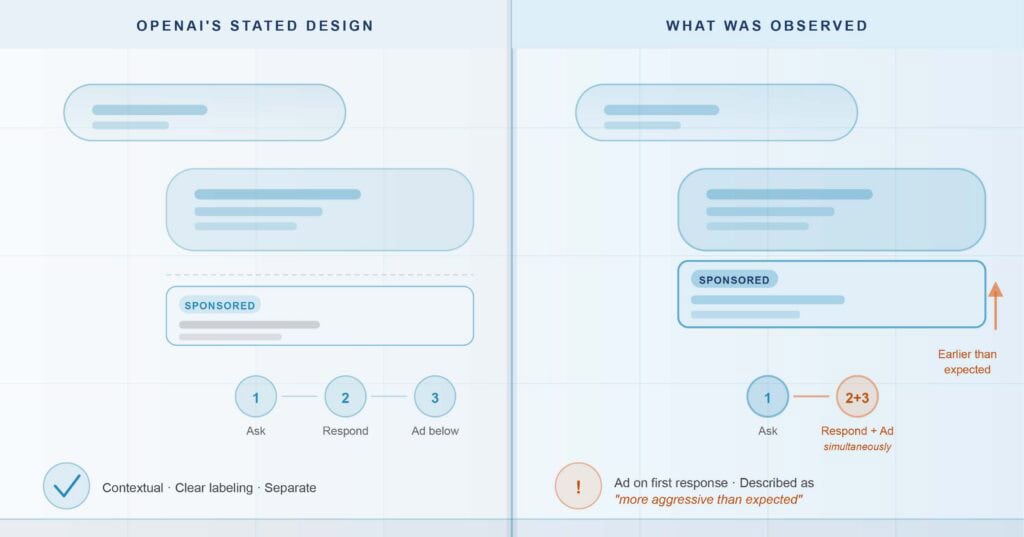
- February 21, 2026: Reports emerge that ads are appearing on users’ very first query, more immediately than OpenAI’s framing had implied. Described by observers as “more aggressive than expected.”[6]
- March 16, 2026: OpenAI confirms the program remains U.S. only with no announced international expansion timeline.[5]
Who Is Eligible to See Ads
Ads are served only to users on the Free and Go ($8/month) tiers. All paid tiers above that, Plus ($20), Pro ($200), Business, Enterprise, and Education, are ad-free.[2]
| Tier | Cost | Sees Ads? | Notes |
| Free | $0 | Yes | Largest user group; primary ad audience |
| Go | $8/mo | Yes | Low-cost tier launched globally Aug 2025 |
| Plus | $20/mo | No | Ad-free; daily professional use |
| Pro | $200/mo | No | Ad-free; research-intensive workflows |
| Business / Ent. | Custom | No | Ad-free; team and enterprise use |
An important clarification: users on the Free tier cannot opt out of ads entirely. They can turn off personalization, which means ads will appear but will be less contextually targeted or they can reduce their daily message limit. The only way to eliminate ads is to pay for a higher tier.[2]
Who the Ad-Eligible Audience Is
The following demographic figures come from secondary industry analysis, not from OpenAI directly, and should be treated as estimates rather than verified data:
- The 25–34 age group is reported as the most active ChatGPT segment; users under 25 are estimated to represent approximately 42% of the total user base.[14]
- Paid subscribers are estimated to be significantly more likely to use ChatGPT in professional contexts than free-tier users, who skew toward personal, educational, and exploratory use.[14]
- Approximately 43% of American college students report using ChatGPT regularly.[14]
- Ads are not served to users under 18, based on behavioral signals, nor near conversations involving health, mental health, or political topics. This is a confirmed OpenAI policy.[2]
3. How the Ads Work: What OpenAI Says vs. What Was Observed
This section distinguishes carefully between OpenAI’s stated design for the advertising system and what independent observers found when ads launched.
OpenAI’s Stated Design
According to OpenAI’s own published materials:[1][2]
- Ads appear below the AI’s response, in a clearly labeled “Sponsored” section, visually separated from the answer.
- The AI’s answer is generated before any ad-matching occurs. The two systems operate independently. OpenAI calls this “Answer Independence.”
- Ads are matched to the conversation using what OpenAI calls contextual intent targeting: the system reads the conversation thread and attempts to match advertiser-defined “intent categories” to what the user appears to be trying to accomplish.
- Advertisers define broad intent profiles rather than keyword lists. A user discussing cash flow might see an accounting software ad, even if they never typed those words.
What Independent Research Found
When ads launched, ad intelligence firm Adthena conducted independent research on how the system behaved in practice. Their findings, reported by Search Engine Land, differed from the impression OpenAI’s framing had created:[6]
- Ads appeared on the very first response to a query. A user who simply asked “What’s the best way to book a weekend away?” saw sponsored placements immediately, before any conversation had developed.
- The ad design, featuring a brand favicon and “Sponsored” label, differed slightly from the examples OpenAI had previously shared publicly.
- The rollout was described by multiple industry observers as “more aggressive than expected,” given OpenAI’s stated emphasis on relevance and careful placement.
| The gap between stated design and actual behavior This discrepancy is not unusual for a new advertising product implementation often differs from how a platform is initially described. What it does illustrate is that OpenAI’s stated principles (careful contextual matching, ads only when “relevant”) and the reality of a system under pressure to generate ad impressions may not always align. Independent verification of how the system behaves is more informative than the company’s own descriptions. |
User Response to Ads
Public response to the announcement and launch of ads was largely negative. According to reporting by Popular AI Tools and others, social media sentiment was overwhelmingly critical within hours of the January announcement.[13] Users expressed:
- Frustration and a sense of trust being broken, given ChatGPT’s previous ad-free status
- Concern that ad revenue incentives would eventually influence the AI’s responses, despite OpenAI’s stated Answer Independence policy
- Interest in moving to paid tiers or alternative AI tools that remain ad-free
- Skepticism about privacy commitments, citing the common pattern of tech platforms that promise not to use data for ads and later do so
OpenAI had faced a preview of this reaction in late 2025, when it tested app suggestions inside ChatGPT that users perceived as unwanted ads, generating backlash before the formal advertising program launched.[3]
4. Privacy: What OpenAI Has Committed to, and What That Means
OpenAI has published explicit privacy commitments for the advertising program. These are its stated policies as of March 2026:
- User conversations are not shared with advertisers.[1]
- User data is not sold to advertisers.[1]
- Advertisers receive only aggregate, anonymized performance data: impression counts and click counts.[2]
- Ad matching occurs within OpenAI’s own infrastructure; advertisers cannot access chat history, memories, or personal details.[2]
- Users can turn off ad personalization. Ads will still appear, but will be less contextually matched.[2]
- OpenAI commits to always maintaining at least one paid tier that is ad-free.[1]
| These are policy commitments, not technical guarantees Every statement above is a policy choice that OpenAI has made and can change. None of them are structural or technical constraints that prevent data from being used differently in the future. They have not been independently audited. Users and advertisers alike should understand the distinction between “OpenAI says it won’t do this” and “This is technically impossible.” The history of digital advertising includes many platforms that made similar early-stage commitments and revised them as commercial pressure grew. |
5. Cost and Access: What Is Actually Required to Advertise
Entry Requirements
ChatGPT advertising is currently accessible only to a small number of large, invited brands. Adweek confirmed that OpenAI required a minimum commitment of $200,000 in ad spend to participate in the beta program.[8] Reporting from The Information indicated that some brands in the earliest wave of testing committed $1 million or more before the February 9 launch.[9]The beta cohort is described as fewer than 100 hand-selected brands.[11]
Companies reported to be participating in early testing include Adobe, Target, Albertsons, and the WPP media group.[12] These are large enterprises with substantial marketing budgets and tolerance for early-stage platform risk. This is not a channel currently accessible to small or mid-sized businesses.
Pricing
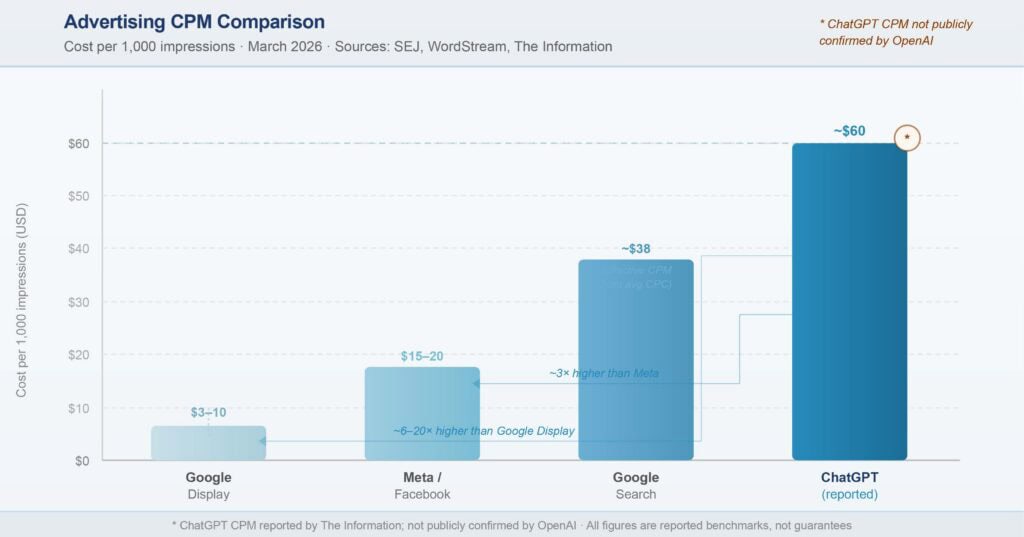
Premium ad placements are reported at approximately $60 per 1,000 impressions (CPM), based on reporting by The Information, cited by Search Engine Journal.[10] OpenAI has not publicly confirmed this figure directly. For context, Google Display advertising typically runs $3–10 CPM; Meta advertising averages $15–20 CPM.[10]
Unlike Google’s search advertising, which charges on a cost-per-click (CPC) basis. Meaning advertisers pay only when a user clicks, ChatGPT ads use a CPM model, meaning advertisers pay per impression regardless of whether a user interacts with the ad. Given the absence of reliable click-through rate or conversion data, the effective cost of acquiring a customer through this channel is currently unknown.
What Advertisers Currently Receive
Early beta participants are receiving weekly CSV export files containing impression and click data.[17] There are currently:
- No real-time reporting dashboards
- No built-in attribution tools to connect ad exposure to downstream conversions
- No A/B testing infrastructure
- No third-party measurement integrations
- No self-serve access for advertisers not in the beta
This is a significant limitation. An advertiser committing $200,000 or more to a channel cannot currently determine, with the tools the platform provides, whether that investment generated any business outcome. Advertisers must construct their own attribution frameworks using external tools, which adds cost and complexity and still cannot directly measure what happens inside the ChatGPT conversation.
6. How ChatGPT Ads Compare to Existing Advertising Models
A common question is whether ChatGPT advertising is a new form of pay-per-click advertising or something different. The structural answer is: it shares some characteristics with search advertising but differs in important ways. What remains genuinely unknown is how it performs.
Structural Similarities to Search Advertising
- Both Google Search Ads and ChatGPT ads are triggered by user intent rather than passive browsing behavior.
- Both place ads adjacent to informational content (search results and AI answers respectively) rather than interrupting media streams.
- Both use a form of relevance matching to determine which ads appear.
Structural Differences
| Dimension | Google Search Ads | ChatGPT Ads (current) |
| Intent signal | Explicit keyword typed by user | Inferred by AI from conversation context |
| Advertiser control | High – keyword lists, bids, match types | Low – AI determines when ad is relevant |
| Pricing model | CPC – pay per click | CPM – pay per 1,000 impressions |
| Attribution | Robust; real-time; third-party verified | Weekly CSV only; no native attribution |
| Transparency | Auction prices and Quality Scores disclosed | Ranking factors not disclosed by OpenAI |
| Entry barrier | Any budget; self-serve immediately | $200K+ minimum; invitation only |
| Performance data | 20+ years of benchmarks across industries | No independent benchmarks exist (as of Mar 2026) |
An Important Distinction: Claims vs. Evidence
Much of the discussion around ChatGPT ads frames the platform’s contextual targeting as inherently more valuable than keyword targeting because it captures what a user “means” rather than what they type. This framing comes largely from OpenAI and from marketing agencies promoting the platform. It is a reasonable hypothesis, but it is not evidence. No independent study has compared conversion rates or customer acquisition costs between ChatGPT ads and existing channels. Any business case built on “high-intent audience” claims from the advertising industry should be read critically.
| The honest state of knowledge ChatGPT ads launched in February 2026. As of this writing, no independent performance data exists. No peer-reviewed studies, no audited case studies, no third-party verified benchmarks. All claims about the effectiveness of the platform including those from OpenAI, from early beta advertisers, and from marketing agencies are either theoretical or based on early, unaudited internal data. Any financial commitment to this platform should be made on the basis of that reality. |
7. Open Questions and Unresolved Issues
The following are genuinely unresolved issues that anyone considering or affected by ChatGPT advertising should be aware of.
Does Answer Independence Hold Under Commercial Pressure?
OpenAI’s stated principle is that ads never influence ChatGPT’s answers. This is a policy commitment, not a technical architecture. As advertising revenue becomes more important to the company’s financial survival, the question of whether this separation is maintained in practice and who would verify it if it weren’t is unresolved. There is currently no independent auditing mechanism for Answer Independence.
How Is Ad Relevance Actually Determined?
OpenAI has not disclosed the ranking factors that determine which ad appears when multiple advertisers qualify for a given conversation. It is not known whether bid amounts influence ad selection or whether relevance is the sole criterion. This lack of transparency differs from Google’s auction system, where pricing signals are disclosed to advertisers.
What Happens to Privacy Commitments as the Platform Scales?
OpenAI’s current privacy commitments are clear. The historical pattern in digital advertising across Google, Facebook, and many other platforms is that privacy commitments made during early-stage rollouts are later revised as commercial pressure increases. There is no reason to assume OpenAI will follow this pattern, but there is also no structural reason it could not. Users who rely on current privacy commitments should monitor them over time.
What Is the Regulatory Outlook?
OpenAI has stated it will not accept political advertising, but has not fully defined where the line between commercial and political content falls in an AI context. Categories such as healthcare, financial services, and climate are simultaneously commercial and politically charged. Industry observers anticipate regulatory scrutiny from the European Union as the program expands internationally, but no specific regulatory action has been taken as of March 2026.[3]
What Is the Real Impact on User Trust?
ChatGPT’s value to users depends substantially on the perception that its answers are objective and not commercially influenced. User backlash at launch was significant and immediate.[13] Whether users adapt to ads over time, as they have in Google Search, or whether advertising meaningfully erodes the trust that differentiates ChatGPT from a conventional search engine, is genuinely unknown. It is one of the most consequential open questions for the platform’s long-term viability.
Summary
ChatGPT advertising is a new program, launched in February 2026, that serves ads to the approximately 94–95% of ChatGPT users who do not pay for a subscription. It exists because OpenAI needs revenue from its free-tier user base to support a business that is not yet profitable.
The advertising system uses contextual matching rather than keyword bidding, serves ads below AI responses, and carries OpenAI’s stated commitment to Answer Independence the principle that ads do not influence what ChatGPT says. When ads launched, independent research found they appeared on users’ first response, more immediately than OpenAI’s framing had implied, and the public reaction was predominantly negative.
Entry to the beta program requires a minimum of $200,000 in spend, with some early participants committing $1 million or more. Reporting tools are limited to weekly CSV files. No independent performance data exists. All projections of platform growth and advertising effectiveness are OpenAI’s own targets or hypotheses from commercially motivated industry sources.
The program raises genuine open questions: whether Answer Independence will be maintained under long-term commercial pressure; how ad relevance is ranked when the algorithm is opaque; how privacy commitments will evolve over time; and whether advertising inside a trusted AI assistant will erode the trust that makes the platform valuable in the first place.
This guide has tried to present what is known, identify what is claimed versus what is independently verified, and flag what is not yet known. Readers are encouraged to draw their own conclusions.
Sources & Bibliography
All factual claims are cited by number. Sources are listed in citation order. Where a source has a commercial interest in the platform, this is noted.
[1] OpenAI. “Our Approach to Advertising and Expanding Access to ChatGPT.” Jan 16, 2026. https://openai.com/index/our-approach-to-advertising-and-expanding-access/
[2] OpenAI. “Testing Ads in ChatGPT.” Feb 9, 2026. https://openai.com/index/testing-ads-in-chatgpt/
[3] TechCrunch. “ChatGPT Rolls Out Ads.” Feb 9, 2026. https://techcrunch.com/2026/02/09/chatgpt-rolls-out-ads/
[4] CNBC. “OpenAI to Begin Testing Ads on ChatGPT in the U.S..” Jan 16, 2026. https://www.cnbc.com/2026/01/16/open-ai-chatgpt-ads-us.html
[5] gHacks Tech News. “OpenAI Confirms ChatGPT Ads Remain Limited to the United States.” Mar 16, 2026. https://www.ghacks.net/2026/03/16/openai-confirms-chatgpt-ads-remain-limited-to-the-united-states/
[6] Search Engine Land / Adthena. “ChatGPT Ads Spotted and They Are Quite Aggressive.” Feb 2026. https://searchengineland.com/chatgpt-ads-spotted-and-they-are-quite-aggressive-469651
[7] Social Media Today. “OpenAI Asks ChatGPT Advertisers for $200K in Commitments.” Feb 1, 2026. https://www.socialmediatoday.com/news/openai-asks-chatgpt-advertisers-for-20k-in-committments/811062/
[8] Adweek / OpenAI. “OpenAI Confirms $200K Minimum Commitment for ChatGPT Ad Beta.” Jan 29, 2026. https://www.adweek.com
[9] The Information / MediaPost. “Beta Brands Begin Testing ChatGPT Ads, Budgets = $1M Each.” Jan 21, 2026. https://www.mediapost.com/publications/article/412189/beta-brands-begin-testing-chatgpt-ads-budgets.html
[10] Search Engine Journal. “PPC Pulse: ChatGPT Ads CPMs, Ads Decoded Talks Analytics.” Feb 6, 2026. https://www.searchenginejournal.com/ppc-pulse-chatgpt-ads-cpms-ads-decoded-talks-analytics/566190/
[11] Storyboard18. “ChatGPT Ads Enter Limited Beta with $200,000 Minimum Spend.” Feb 2, 2026. https://www.storyboard18.com/digital/chatgpt-ads-enter-limited-beta-with-200000-minimum-spend-88645.htm
[12] The Next Web. “The Other Side of Ads in ChatGPT: Advertiser Perspective.” Mar 2026. https://thenextweb.com/news/the-other-side-of-ads-in-chatgpt-advertiser-perspective
[13] Popular AI Tools. “ChatGPT Ads in 2026: The Definitive Guide.” Mar 2026. https://popularaitools.ai/chatgpt-ads/
[14] Backlinko / Semrush. “ChatGPT Statistics 2026: How Many People Use ChatGPT?.” Dec 2025. https://backlinko.com/chatgpt-stats
[15] Business of Apps. “ChatGPT Revenue and Usage Statistics (2026).” Jan 2026. https://www.businessofapps.com/data/chatgpt-statistics/
[16] eMarketer. “ChatGPT $200K Minimums for Ad Beta Signals OpenAI’s Push to Monetize Scale.” Feb 2, 2026. https://www.emarketer.com/content/chatgpt–200k-minimums-ad-beta-signals-openai-s-push-monetize-scale
[17] ALM Corp. “ChatGPT’s Ads Manager: What OpenAI’s $200K Entry Bar Means for Marketers.” Mar 2026. https://almcorp.com/blog/chatgpt-ads-manager-openai-advertising-platform-2026/
